CVT Belts and Rollers: When They're Worn and How to Change Them
A 50cc has no gears to shift. A rubber belt and six little rollers do the shifting for you, and when they wear, the bike tells you — slower off the line, slower on top, or jerky in between. Both parts are cheap, and swapping them is a Saturday-morning job with basic tools.
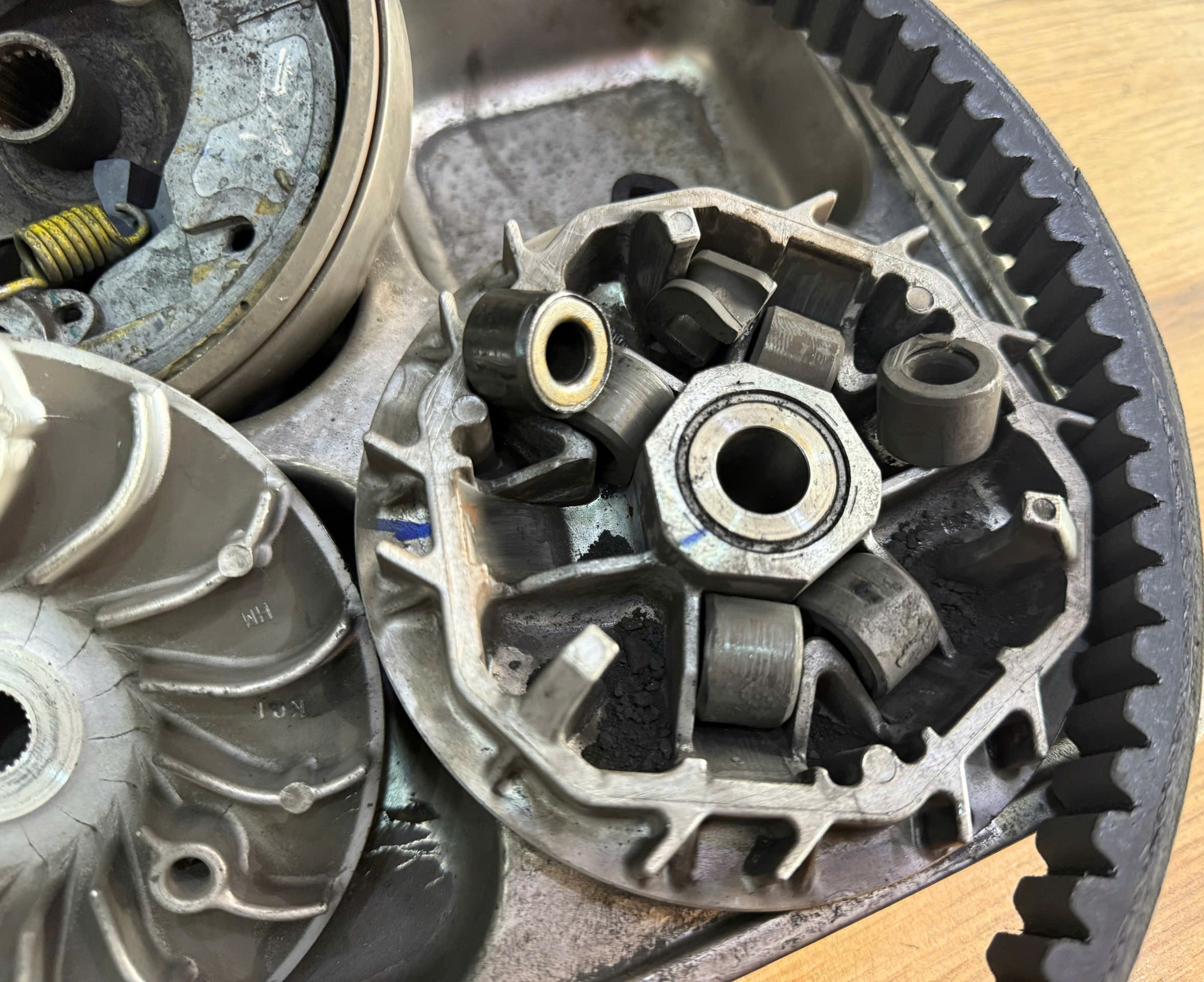
How the CVT does the shifting
The engine spins the front pulley, called the variator. Six rollers sit in ramps inside it. As RPM rises, centrifugal force flings the rollers outward, pushing the variator faces together and forcing the belt to ride higher on the pulley — that is a taller gear. At idle the rollers drop back and the belt rides low — a shorter gear. The rear pulley opens and closes against a spring to take up the slack, and the clutch engages the rear wheel. No gears, no shifter, no clutch lever. Just physics — and two wear parts.
Signs the belt is done
- Top speed drops a few mph for no other reason. A worn belt is narrower, so it cannot ride high enough in the variator to reach full ratio. This is the most common symptom and the most misdiagnosed — people chase carb and exhaust problems when the belt is just thin.
- Slipping or surging on hills, a rubber smell, or a squeal from the CVT case.
- What you see when you look: cracks or missing chunks on the inner cogs, frayed edges, glazed shiny sides, or oil on the belt. Any one of those means replace it. An oil-soaked belt means replacing the belt and cleaning the pulley faces, or the new one slips too.
One honest note: a brand-new belt slips slightly for the first miles. A short run-in is normal, not a defect — judge a new belt after a ride or two, not in the driveway.
Signs the rollers are done
- Jerky or surging takeoff, RPM that hunts up and down at steady throttle, or a vibration that was not there before. Flat-spotted rollers are the usual cause.
- The flat-surface test: pull the rollers out and roll each one on a flat table. A flat spot shows up as a stop or a wobble. Weigh them on a cheap gram scale while you are at it — a set should match. One light or flat roller is enough to make the shift uneven.
- Rollers run dry. No grease in the variator. Grease plus belt dust turns into paste that sticks rollers in their ramps, which causes exactly the surging you are trying to fix.
What to order
- Belt: read the number printed on your old belt. On a short-case 139QMB it is usually 669-18-30 — 669 mm long, 18 mm wide. Long-case engines usually take 729-17.7-30. Do not order from wheel size alone: two bikes that look the same can take different belts, and the number on the old belt settles it.
- Rollers: 16x13 mm for a 139QMB. Weight varies by brand, so weigh one of yours before ordering instead of guessing. Buy a full set of six, all the same weight.
- Buy a belt from a known belt maker — Gates, Bando, or Mitsuboshi. The cheapest no-name belts are the ones that shred in a few hundred miles, and a shredded belt strands you the same as a broken one.
Changing them
- Cover off. Left side of the engine, a ring of small bolts. Blow the belt dust out while you are in there — it builds up and holds heat.
- Slack the belt first. Squeeze the rear pulley open by hand and push the belt deep into it. That gives you the slack to get the belt off the front variator.
- Hold the variator properly — a variator holding tool, or an impact wrench on the nut. Do not wedge things in the cooling fins to hold it; the fins break.
- Note how the rollers sit in their ramps before you dump them out, and put the new ones in the same way, dry.
- Belt back on: rear pulley first, seated deep, then over the front. If the belt has rotation arrows, point them the right way.
- While you are in there, look at the clutch bell. Blue or glazed spots mean it has been overheating, and that is a separate problem worth knowing about.
The front variator face must sit flush on the boss, with no splines showing, before the nut goes on. If the belt is not seated deep enough in the rear pulley, the front face will not close fully — and a nut tightened onto a half-closed variator works loose, then the variator chews itself up. If you can see splines between the face and the boss, stop and seat the belt deeper. Blue threadlocker on the nut, 30–35 ft-lb — the commonly published figure for the M12 variator nut; your manual wins if it differs.
Tuning with roller weight (optional)
Roller weight is the one free tuning adjustment a stock CVT gives you, and the rule is simple:
- Lighter rollers — the engine revs higher before the CVT shifts up. Snappier takeoff, less top speed.
- Heavier rollers — the CVT shifts up earlier. Lazier takeoff, more top speed, up to what the little engine can actually pull.
- Change in 0.5–1 gram steps, full set, all six the same. Never mix weights in a set on a stock bike.
If the stock setup feels right, leave it. Roller tuning fixes a specific complaint — sluggish takeoff or a bike that never reaches top speed — it is not a free power mod. If you want real speed, that is a different article.
How often
Look inside every season, or every few thousand miles. The published rule of thumb for belts is roughly 10,000–20,000 km, but condition beats mileage: a belt that lives in heat and dust can be done sooner, and a garage-kept one can go longer. Rollers get checked whenever the belt is off, or at the first sign of surging — and when they go, replace the whole set, not one.
That is the whole job. Two cheap parts, one cover, and the bike shifts like it should again.
Keep reading
 Repair & Maintenance· 8 min read
Making a 50cc Faster: The Honest Upgrade Path, Stage by Stage
CVT tuning, big-bore kits, and the real numbers on what each dollar buys — plus the one upgrade that quietly kicks you out of moped class.
Read the article → Repair & Maintenance· 6 min read
New Crate Scooter? The First-Service Checklist Before You Really Ride It
A crate GY6 is a kit that happens to look like a scooter. Ninety minutes with a socket set on day one prevents the breakdowns owners blame on the bike later.
Read the article → Repair & Maintenance· 8 min read
My 50cc Scooter Won't Start: The GY6 Troubleshooting Order
Don't start by buying parts. Start with the free checks, in the order that rules out the most causes per minute.
Read the article →