Why Your 50cc Won't Start After Sitting
It ran when you parked it. Weeks later it just cranks. Start with the two-minute test that splits fuel from spark, then work the five causes sitting actually creates.
First, the branch test
Before you take anything apart, split the problem in half. Every no-start is either no fuel, no spark, or (rarely) no compression — and a shot of starting fluid is the fastest way to find out which.
Pull the air filter or open the airbox, give it a one-second shot of starting fluid (or carb cleaner), and hit the starter. If it fires and dies, you have spark — your problem is fuel, and it's items 1–3 below. If it does nothing at all, skip to item 4: spark. One warning: if you've been cranking for minutes already, you may have flooded it — a strong gas smell and a wet plug mean hold the throttle wide open while cranking to clear it, or pull the plug and let it dry.
1. The gas went bad
Modern pump gas starts going stale in as little as 30 days, and ethanol-blend fuel absorbs water from the air while it sits. Old gas smells wrong — sour, like varnish instead of gasoline. A 139QMB that sat a month or more on untreated gas is guilty until proven innocent.
The fix costs nothing but time: drain the tank, then open the drain screw on the bottom of the carb float bowl and let the old fuel out of there too — the bowl is what the engine actually drinks first. Refill with fresh gas. If it sat all winter, plan on item 3 as well, because whatever the stale gas left behind is now in the carb.
2. The vacuum petcock isn't delivering
Most 139QMBs don't have a fuel valve you turn. They have a vacuum petcock: fuel only flows when engine vacuum pulls a diaphragm open. Sitting dries that diaphragm out, cracks the little vacuum hose, or sticks the valve shut — and the engine starves with a full tank.
Test it in two minutes: pull the fuel line off the carb, point it into a cup, and crank. Fuel should pulse out while cranking. No fuel? Check the other, thinner hose — that's the vacuum line, and a crack anywhere in it means no vacuum and no fuel. Swap either hose for a few dollars of new line before you condemn the petcock itself; dried-out hoses cause this more often than the valve does.
3. The pilot jet is clogged
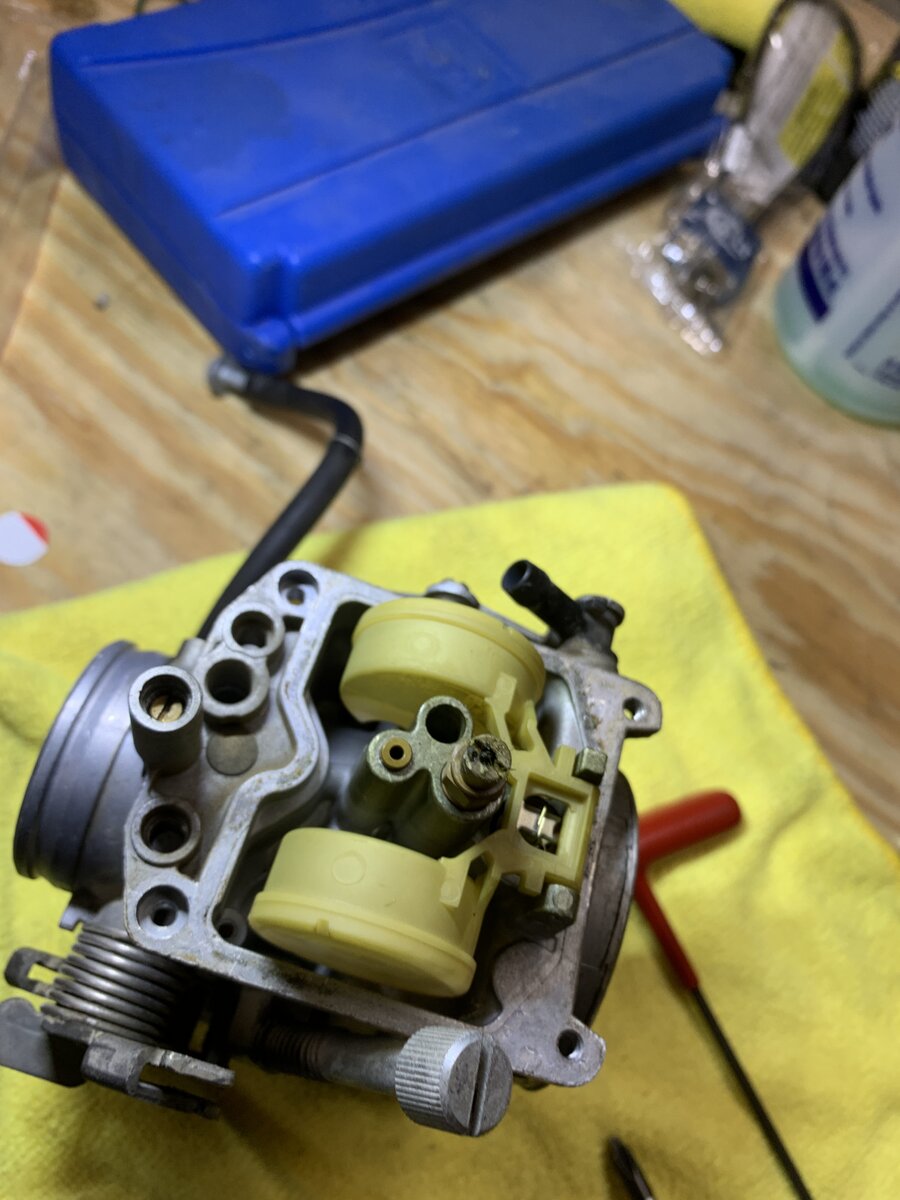
The single most common reason a GY6 won't start after sitting. The pilot (idle) jet has the smallest hole in the carb — stock is usually a #35 — and varnish from evaporating gas plugs it solid while the bigger main jet stays clear. The result is a bike that might start on starting fluid or with the throttle held open, then dies the second it has to idle on its own.
There's no shortcut around it: pull the carb, drop the float bowl, unscrew the pilot jet, and hold it up to the light. If you can't see a clean round hole, it's clogged. A single strand from a wire brush or a guitar string, plus carb cleaner and compressed air, opens it. Forcing anything bigger through it ruins it — the hole is the calibration. A replacement jet costs a few dollars; read the size stamped on the old one before you order.
4. No spark
Less common from sitting alone, but corrosion doesn't take time off. Pull the plug, reconnect the cap, hold the threads against the cylinder head, and crank. You want a fat blue spark snapping across the gap. Orange and lazy, or nothing at all, means work this list:
- The plug itself. Fouled or fuel-soaked plugs are cheap and common. Stock is an NGK C7HSA, gapped .024–.028". When in doubt, a new plug rules out the whole category.
- The plug cap and wire. Caps unscrew from the wire and corrode green inside. Snip a quarter inch of wire and rethread the cap for a fresh connection.
- The kill switch and connectors. Switches that sit get crusty. Cycle the kill switch a few times, and unplug/replug the CDI connections — half of "no spark" on a stored bike is a green connector, not a dead part.
One thing in your favor: most 139QMBs run an AC CDI that makes spark from the stator, not the battery. A bike with a battery too weak to crank will often still spark — and many will kick-start (if yours has the lever) with a nearly dead battery. If it starts on the kicker but not the button, your engine was never the problem: it's the battery or starter circuit.
5. The battery gave up
Last because it fools people into bigger jobs. A small scooter battery that sits discharges, then sulfates, then won't take a charge. Symptoms: slow crank, a click instead of cranking, or a starter that sounds tired by the third try. A healthy resting battery reads 12.4–12.8 volts; under 12.2 after sitting is a battery asking to be replaced, not charged. And remember the flip side from item 4 — a weak battery also means slow cranking, which means weak vacuum pulses, which means the petcock in item 2 barely opens. Batteries cause more "fuel problems" than fuel does.
So it never happens again
- Ride it. Ten minutes every couple of weeks beats every product on this list.
- Stabilizer, or drain it. If it must sit a month or more: fuel stabilizer in a full tank, run it five minutes to get treated fuel into the carb — or drain the tank and bowl and skip the chemistry entirely.
- Ethanol-free gas for storage, if your area sells it. It ages slower and doesn't pull water.
- A battery tender on any bike that sits. A $20 tender saves a $40 battery every single time.
The honest summary of this whole article: if a 50cc sat, suspect what sitting does — old gas, a dried-out petcock, a plugged pilot jet — before you suspect the engine. The engine was fine when you parked it. It usually still is.
Keep reading
 Repair & Maintenance· 8 min read
My 50cc Scooter Won't Start: The GY6 Troubleshooting Order
Don't start by buying parts. Start with the free checks, in the order that rules out the most causes per minute.
Read the article → Repair & Maintenance· 7 min read
Cleaning a GY6 Carburetor (and the Jets Ethanol Loves to Plug)
Sits for a month, cranks forever, maybe fires and dies. Nine times out of ten on a small GY6, that's a pilot jet wearing a coat of ethanol varnish.
Read the article → Repair & Maintenance· 6 min read
New Crate Scooter? The First-Service Checklist Before You Really Ride It
A crate GY6 is a kit that happens to look like a scooter. Ninety minutes with a socket set on day one prevents the breakdowns owners blame on the bike later.
Read the article →